

 المعلومات
High-Precision CNC Machining: Revolutionizing Custom Insulation for Next-Generation Transformers
How Advanced Dielectric Material Processing Ensures Superior Electrical Integrity, Thermal Stability, and Grid Reliability١٨/٧/٢٠٢٦The global electrical grid is currently undergoing an unprecedented large-scale transformation. Driven by the growing integration of renewable energy sources, the rapid expansion of electric vehicle (EV) charging infrastructure, and the ongoing modernization of industrial power systems, the demand for high-efficiency transformers has reached an all-time high.
To meet these strict modern application requirements, transformer manufacturers are gradually moving away from standard off-the-shelf components. Instead, the industry now relies heavily on precision CNC (Computer Numerical Control) machining of advanced insulation materials to ensure operational safety, prevent catastrophic dielectric breakdown, and effectively extend the service life of equipment.
The Vital Role of Insulation Materials in Modern Transformers
In both liquid-immersed and dry-type transformers, insulation materials perform a dual core function: they act as a reliable dielectric barrier to prevent short circuits and withstand strong electromagnetic forces, while also supporting efficient heat dissipation at the same time.
As transformers are designed to operate at higher voltage levels and adopt more compact structural designs, the performance tolerance margin for these insulation materials has become increasingly narrow. Conventional cutting or manual shaping processes can no longer meet these strict requirements. Micro-tears, rough edges, or even minor dimensional deviations can lead to localized electrical stress concentrations—known as partial discharge—which will eventually cause complete insulation failure.
Why CNC Machining is Critical for Transformer Insulation Parts
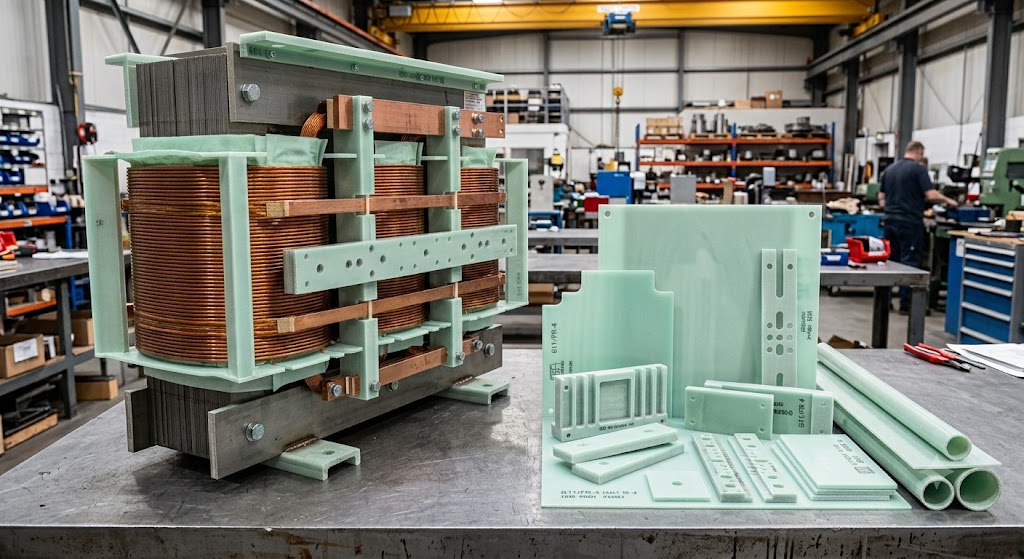
CNC machining effectively bridges the gap between advanced material science achievements and rigorous structural engineering requirements. Through the use of multi-axis CNC milling, routing, and turning processes, manufacturers can process raw insulation sheets, tubes, and rods into highly complex components with extremely precise tolerance control.
- Tight Tolerances for Critical Clearances: Modern CNC equipment can achieve control accuracy within micrometer-level tolerances. This high level of precision is critical for components such as core insulation, step spacers, and winding support blocks, where even a deviation of a fraction of a millimeter will directly affect the mechanical integrity of the entire coil assembly.
- Edge Quality and Delamination Prevention: Composite materials such as epoxy glass laminates are prone to delamination or fraying if processed with inappropriate techniques. Specialized CNC tooling combined with optimized spindle speed settings ensures clean, burr-free edges, fully preserving the structural and dielectric strength of the material.
- Complex Geometric Capabilities: From intricate oil flow channels inside spacers to custom-molded insulating washers, CNC routing supports the processing of complex geometries that optimize cooling performance and effectively regulate oil or air circulation within the transformer housing.
Key CNC Machined Insulation Materials for the Transformer Industry
Different transformer application scenarios require insulation materials with specific performance characteristics. CNC machining centers routinely process a wide range of high-performance materials tailored to various transformer application needs:
1. FR-4 & G10 / G11 Epoxy Glass Laminates
These materials are characterized by extremely high mechanical strength, low moisture absorption, and excellent electrical insulation properties in both dry and humid environments. CNC-machined G11 is widely used for high-temperature structural supports, terminal boards, and slot insulation in heavy-duty power transformers.
2. Phenolic Cotton and Paper Laminates (3025 / 3021)
These laminates provide reliable mechanical wear resistance and stable dielectric performance, and are precision-machined into durable spacer rings, gear components, and structural panels for distribution transformers.
3. Laminated Wood (Permali / Transformer Wood)
Made from selected beech veneers impregnated with synthetic resins, insulating laminated wood offers the advantages of low density, high mechanical strength, and excellent oil compatibility. CNC routing processes this material into large core clamping plates, support blocks, and pressure rings for oil-immersed transformers.
4. Engineering Plastics: PTFE, Nylon, and POM
For specialized dry-type or traction transformers, CNC-machined PTFE or heavy-duty Nylon components provide exceptional thermal tracking resistance, self-lubricating properties, and high impact resistance.
Enhancing Transformer Reliability with Custom CNC Solutions
Each transformer project comes with unique design specifications. Investing in custom CNC-machined insulation components ensures that every barrier, spacer, cleat, and segment fits perfectly into the final assembly. This precise fit minimizes air gaps, reduces mechanical vibration under short-circuit conditions, and optimizes the thermal profile of the entire winding structure.
By partnering with an experienced insulation material supplier equipped with advanced CNC processing capabilities, transformer OEMs can shorten their production timelines, eliminate in-house machining scrap rates, and significantly improve the overall grid reliability of their end products.