

 Informations
What is G10 Epoxy Glass Laminate? Properties, Applications, and Machining Guide
Everything You Need to Know About G10 Sheet, Rod, and Tube: Properties, Uses, and Machining Best Practices.07/08/2026When engineers and procurement managers need a material that offers extreme mechanical strength, high dimensional stability, and excellent electrical insulation, G10 epoxy glass composite is often at the top of the list.
While widely recognized for its ruggedness in high-stress industrial components, selecting the right grade and understanding how to machine G10 effectively can be tricky. In this ultimate guide, we’ll break down everything you need to know about G10 material—from its manufacturing process and key properties to grade comparisons (G10 vs. FR4 vs. G11) and machining best practices.
What is G10 Material Made Of?
G10 is a high-pressure thermosetting industrial laminate consisting of a woven continuous filament fiberglass cloth impregnated with an epoxy resin binder.
The Manufacturing Process:
- Prepreg Preparation: Continuous alkali-free glass fiber fabric is thoroughly saturated with a premium epoxy resin formulation and cured to a "B-stage" (prepreg).
- Layering & Stacking: Multiple layers of prepreg fabric are stacked to achieve the desired finished thickness.
- High-Pressure Molding: The material is placed under extreme heat and pressure in a hydraulic press. This process fully polymerizes the epoxy resin, thermosetting the layers into a dense, solid, and homogenous structure that cannot be remelted.
G10 is most commonly produced in sheets, rods, and tubes, serving as the foundation for custom CNC precision machined parts.
Key Technical Properties & Benefits of G10
G10 stands out among composite materials due to its unmatched balance of mechanical and electrical characteristics:
- Superior Mechanical Strength: G10 retains exceptional flexural, impact, and tensile strength even in harsh environmental conditions.
- Outstanding Electrical Isolation: It exhibits high dielectric strength and electrical breakdown voltage, making it ideal for high-voltage insulation.
- Low Water Absorption: With a moisture absorption rate close to zero (typically <0.10%), G10 maintains its electrical and dimensional properties in humid or wet environments.
- Chemical and Corrosion Resistance: The cured epoxy resin resists a wide variety of chemical solvents, acids, and alkalis without rusting or degrading.
- Dimensional Stability: It experiences minimal creep or thermal expansion, ensuring tight tolerances for precision engineered components.
G10 vs. FR4 vs. G11: How to Choose the Right Grade?
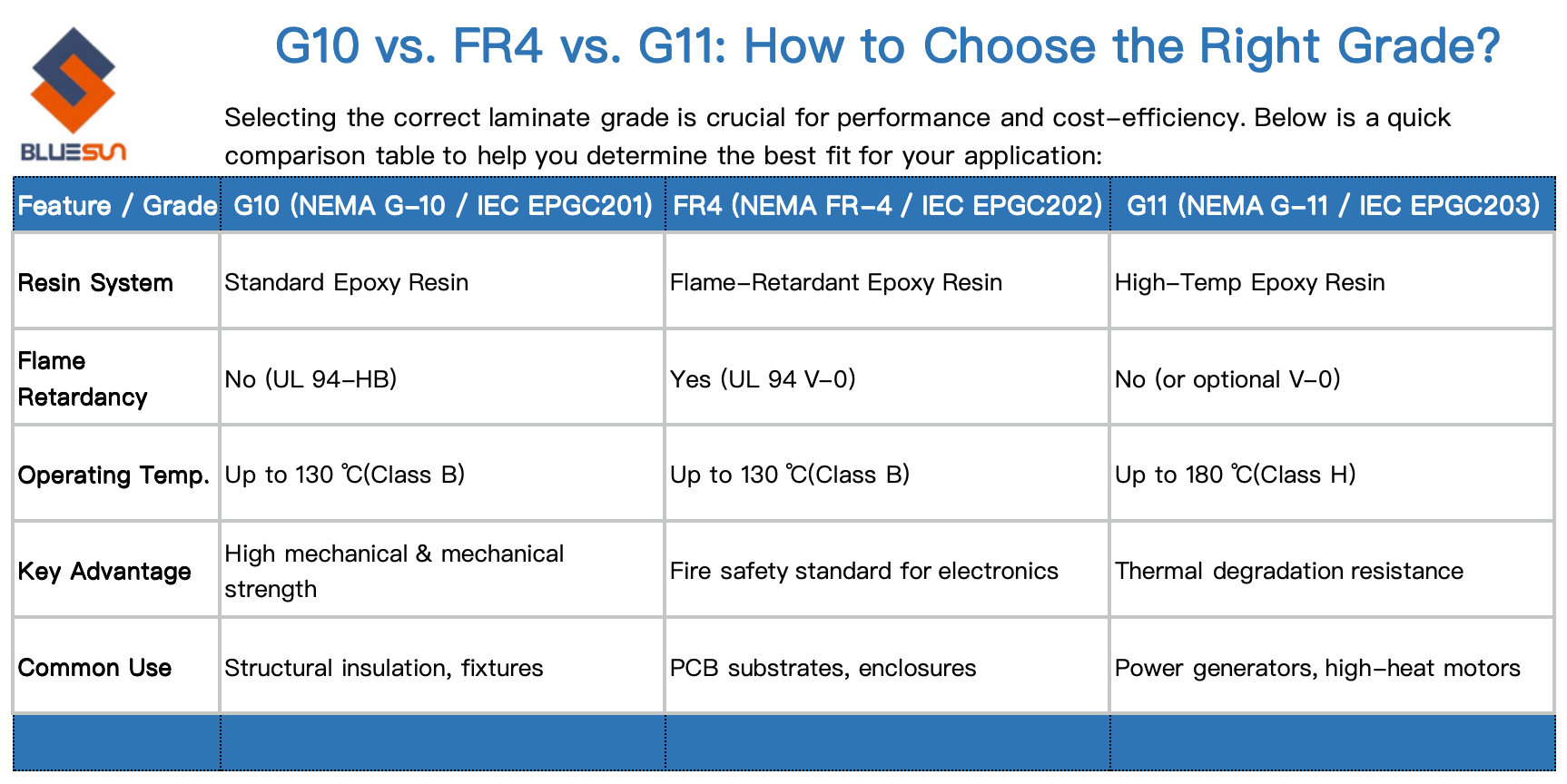
Selecting the correct laminate grade is crucial for performance and cost-efficiency. Below is a quick comparison table to help you determine the best fit for your application:
Common Applications of G10 Epoxy Glass Sheets
Thanks to its versatility, G10 is widely specified across multiple demanding industries:
- Electrical & Power Distribution: Transformer insulation barriers, switchgear components, busbar insulation, terminal boards, and slot wedges.
- Oil, Gas & Chemical Processing: Corrosion-resistant structural supports, cryogenic insulation flanged gaskets, and chemical valve parts.
- Mechanical & Industrial Tooling: Zero-clearance inserts, star wheels, structural spacers, and precision CNC testing fixtures.
- Outdoor & Sporting Goods: High-grip knife handles (scales), firearm grips, marine equipment mouting plates, and archery bow limbs.
Practical Machining Tips for G10
Because G10 contains high proportions of abrasive glass fibers, machining it requires specialized tooling and strict safety protocols.
Best Practices for Machining G10:
- Tooling Selection: Avoid standard High-Speed Steel (HSS) tools, as glass fibers will dull them rapidly. Use Carbide (PCD) or Diamond-Coated tooling to achieve clean cuts and long tool life.
- Dust Control & Safety: Dry machining creates fine fiberglass dust that can irritate lungs and skin. Always use high-efficiency HEPA vacuum extraction systems or wet machining setups with dust collection, along with proper PPE (masks and eye protection).
- Delamination Prevention: Maintain high spindle speeds with fast feed rates, and use backing boards when drilling through sheets to prevent laminate breakout or layer separation.
Partner with a Trusted Epoxy Fiberglass Manufacturer
Choosing the right grade of G10 laminate is essential to ensuring safety, longevity, and performance in your products. Whether you need standard G10 sheets, high-temperature G11, fire-retardant FR4, or custom CNC machined components built strictly to drawing specifications, we are here to help.
Looking for high-quality G10/FR4/G11 laminates or custom machining services?
[Contact Bluesun Team Today] to request technical datasheets, free samples, or a fast factory-direct quote!