

 News
NewsUse of G10 Glass Epoxy Sheet in Electronic Products
As a professional epoxy glass fiber sheet manufacturing factory, Blue Sun will share the use of high mechanical strength G10 glass epoxy sheet in electronic products.7/21/2025In the dynamic landscape of electronic product development, the selection of materials plays a critical role in determining product performance, durability, and safety. Among the various composite materials available, G10 glass epoxy sheet has emerged as a preferred choice for many manufacturers, particularly in applications requiring high mechanical strength and excellent insulation properties. In this blog post, as a professional epoxy glass fiber sheet manufacturing factory, Blue Sun will share the use of high mechanical strength G10 glass epoxy sheet in electronic products.
What Is G10 Glass Epoxy Sheet for sale?
G10 is a high-pressure fiberglass laminate, a type of composite material that is created by layering glass cloth soaked in epoxy resin and compressing it under heat until the layers cure into a solid sheet. It belongs to the FR-4 family of materials but is not flame retardant, unlike FR-4. The primary appeal of G10 lies in its superb mechanical properties, dimensional stability, moisture resistance, and electrical insulation.
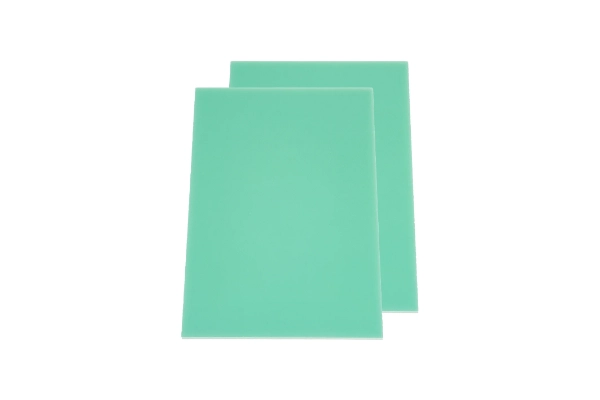
Key Properties of G10 Material
The reliability and broad applicability of G10 sheets stem from their unique combination of physical, mechanical, and electrical characteristics:
- High Mechanical Strength: G10 exhibits exceptional tensile, compressive, and flexural strength, making it suitable for structural applications that demand resilience under stress.
- Electrical Insulation: With a high dielectric strength and low electrical conductivity, G10 is widely used as an insulating material in high-voltage and high-frequency environments.
- Moisture and Chemical Resistance: G10 does not absorb water easily and is resistant to many chemicals, making it ideal for use in humid or corrosive settings.
- Thermal Stability: G10 maintains its shape and performance over a wide temperature range, typically from -40°C to +130°C.
- Machinability: It can be machined, drilled, and cut with precision, enabling customized parts for specific applications.
Application in Printed Circuit Boards (PCBs)
One of the most prominent uses of G10 glass epoxy sheets is in the manufacture of printed circuit boards. While FR-4 is the industry standard for PCBs, G10 is still widely used in specific applications where flame retardancy is not essential. Due to its excellent dielectric properties and mechanical durability, G10 provides structural support and insulation for circuit components. It serves as the substrate for mounting electronic parts, maintaining mechanical integrity while insulating conductive paths.
Use in Insulating Components
In high-voltage environments such as transformers, relays, and switchgear, insulation is vital to prevent electrical faults and ensure safe operation. G10’s dielectric strength and resistance to arc tracking make it a preferred material for fabricating insulation components. These may include terminal boards, insulating sleeves, and mounting brackets.
Structural and Support Applications
In addition to its electrical applications, G10 is often used for structural purposes within electronic devices. Enclosures, support frames, and backing plates made from G10 provide both rigidity and durability. Because of its mechanical stability, it is especially useful in devices subject to mechanical stress, vibration, or impact.
Thermal Management and Heat Shields
Although not a high-performance thermal conductor, G10’s stability under heat and flame-free properties make it suitable for use in non-metallic heat shields and barriers. In electronic assemblies that generate localized heat, G10 sheets can serve as protective layers to isolate sensitive components from thermal stress without conducting excess heat to other regions.
Application in Consumer Electronics
G10 sheets find application in a wide variety of consumer electronics. For example, in high-end audio equipment, G10 is used for chassis components due to its vibration-dampening qualities. In handheld and portable devices, it is often chosen for internal support frames because of its light weight and toughness. Additionally, it is utilized in drones, RC equipment, and other smart devices requiring a combination of electrical insulation and mechanical stability.
Advantages over Alternative Materials
Compared with other insulating materials such as phenolic laminates or plastic-based substrates, G10 offers superior mechanical strength, better dimensional accuracy, and higher resistance to moisture and solvents. While metals like aluminum may provide better thermal conductivity, they lack the insulating properties of G10, which is critical for electronic applications.
Design Flexibility and Custom Fabrication
G10 glass epoxy sheets can be manufactured in a range of thicknesses and can be machined into complex shapes, making them highly adaptable to custom design requirements. Their compatibility with CNC machining and laser cutting makes them ideal for producing prototypes as well as high-volume production parts.
Environmental and Safety Considerations
Although G10 is not inherently flame retardant, it does not release toxic fumes under normal operating temperatures and remains stable in demanding environmental conditions. In terms of environmental compliance, G10 can meet RoHS and REACH regulations if processed correctly, contributing to safer and more sustainable electronic manufacturing.
Conclusion
The use of high mechanical strength G10 glass epoxy sheets in electronic products underscores the importance of selecting materials that balance performance, safety, and reliability. With its exceptional mechanical, electrical, and chemical properties, G10 continues to be an integral material in a wide range of electronic and industrial applications. As electronic systems become more compact and complex, the demand for materials like G10—offering strength, insulation, and adaptability—will only increase, cementing its place as a critical enabler of modern electronic innovation.