

 訊息
訊息In the electrical and power industries, the demand for materials that offer exceptional mechanical strength, electrical insulation, chemical resistance, and thermal stability is paramount. One such material that has proven its reliability in high-performance electrical applications is the G10 epoxy glass laminate sheet. This thermoset composite, composed of woven glass fabric impregnated with epoxy resin under high pressure and heat, exhibits excellent dimensional stability and electrical insulating properties. This makes it a preferred choice in transformer design, manufacturing, and operation. In this blog post, as high quality epoxy resin laminate manufacturing factory, Blue Sun will share the application of G10 epoxy glass laminate sheet in transformer.
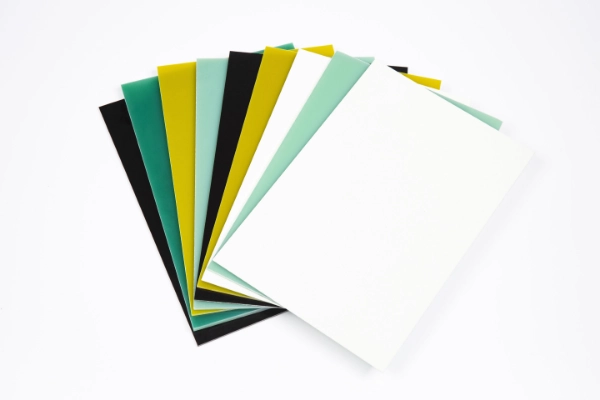
1. Overview of G10 Epoxy Glass Laminate Sheet
Before delving into the specific applications in transformers, it is important to understand the composition and properties of G10 laminate. Classified under the NEMA (National Electrical Manufacturers Association) grade for thermosetting glass epoxy laminates, G10 is a glass-reinforced epoxy material known for:
- High dielectric strength
- Low water absorption
- Excellent mechanical strength
- Chemical and corrosion resistance
- Flame retardancy (in some modified versions like FR4)
These characteristics make G10 particularly suitable for environments where consistent electrical insulation and mechanical performance are critical, such as within power and distribution transformers.
2. Application of G10 Epoxy Glass Laminate in Transformer
One of the primary applications of G10 epoxy glass laminate sheets in transformers is as inter-phase and inter-layer insulation between the windings. Transformers operate at high voltages and require robust insulation to prevent electrical arcing or short circuits. G10 sheets are machined into various shapes such as spacers, barriers, and supports that are inserted between windings or between the windings and core.
Key Roles Include:
- Layer-to-layer insulation in multi-layer coil windings to prevent voltage breakdown.
- Phase barriers between high-voltage phases, especially in three-phase transformers.
- Core support insulation, where G10 parts are used to isolate the core from grounded structures.
Its dimensional stability ensures that the sheet does not deform under high thermal or electrical loads, making it an ideal choice for long-term reliability in transformer insulation.
3. Structural Components and Mechanical Supports
G10 epoxy glass laminate is also utilized for various mechanical and structural applications inside transformers due to its high tensile and flexural strength. It can be used to fabricate:
- Clamping plates and end frames to hold windings securely.
- Support beams and rods in dry-type transformers.
- Mounting brackets and hardware insulation components where both structural load-bearing and electrical insulation are needed.
Unlike metallic components, G10 parts do not conduct electricity, which reduces the risk of unintended ground paths or magnetic interference.
4. Use in Dry-Type Transformers
Dry-type transformers, which are increasingly used in commercial, industrial, and renewable energy applications, benefit significantly from G10 laminate components. Because these transformers operate without oil for cooling and rely on air or resin encapsulation, thermal and moisture resistance are vital for internal components.
G10 sheets are frequently used in dry-type transformers as:
- Coil support boards due to their moisture resistance.
- Phase separators that can endure high temperatures and still maintain electrical performance.
- Terminal insulators and bushings where both electrical isolation and mechanical integrity are needed.
G10' s ability to retain its insulating properties in humid or warm environments enhances the overall efficiency and lifespan of dry-type transformers.
5. High-Voltage Bushings and Terminal Insulation
Bushings serve as the interface between the energized interior of the transformer and external circuits. G10 epoxy glass laminate sheets are used to fabricate high-voltage bushing insulation parts, especially in custom or compact transformer designs.
The material is machined into collars, washers, and sleeves that insulate terminals and prevent electrical flashover. G10' s resistance to tracking, arc resistance, and excellent electrical insulation at high frequencies make it an ideal material for these critical, high-stress components.
6. Control and Protection Systems Integration
Transformers often contain embedded control circuits and sensors for protection and monitoring. G10 laminate sheets are often employed as substrates and insulation mounting plates for:
- Control relays
- Protection fuses
- Thermistors and temperature sensors
- Voltage regulators
The low outgassing, excellent machinability, and stable dielectric properties of G10 make it a preferred material for precision sensor integration, especially where signal fidelity and insulation integrity are essential.
7. Arc Chutes and Spark Suppression Barriers
In power transformers, especially those used in switchgear applications, internal arcing is a significant risk. G10 epoxy laminate sheets, with their high arc resistance, are used to manufacture arc chutes and spark barriers. These components are designed to:
- Quench electrical arcs between contacts during circuit interruption.
- Prevent arc propagation to sensitive areas.
- Serve as flame barriers in case of internal faults.
When combined with flame-retardant additives or when using variants like FR4, G10 becomes an even more effective material for internal arc control.
8. Maintenance and Retrofit Applications
G10 epoxy glass laminate sheets are also extensively used in repair, refurbishment, and retrofitting of aging transformers. Their compatibility with CNC machining, laser cutting, and manual fabrication enables on-site customization. Typical retrofit applications include:
- Replacement insulation parts for obsolete designs.
- Custom brackets and spacers for winding realignment.
- Shims and pads to correct core-coil alignment.
This flexibility reduces downtime and extends the service life of transformers, offering significant cost savings for utilities and industrial operators.
9. Environmental and Safety Considerations
With increasing focus on sustainability and environmental safety, G10' s non-toxic nature and resistance to moisture and chemicals ensure it poses minimal risk of contamination in oil-filled transformers. Moreover, when used in dry-type or cast resin transformers, G10 contributes to overall fire safety due to its thermal stability and flame resistance.
From a safety perspective, the dielectric strength of G10 helps maintain safe working conditions by preventing leakage currents and inadvertent grounding during transformer operation and maintenance.
10. Conclusion
The applications of G10 epoxy glass laminate sheet in transformer engineering are both diverse and critical. Its combination of high electrical insulation, mechanical strength, and environmental resistance positions it as a core material in modern transformer design. Whether as structural support, dielectric barrier, bushing insulation, or arc suppressant, G10 enhances transformer reliability, safety, and service life.
With the power industry transitioning to more compact, efficient, and maintenance-friendly systems, the demand for high-performance materials like G10 will only increase. By integrating G10 laminate sheets into core transformer components, manufacturers and utility companies can ensure higher operational efficiency, lower failure rates, and improved lifecycle performance.